Suppose you're working on a multicultural marketing campaign and preparing the assets. You hire a copywriter who's carefully picking the words to turn a block of letters into a powerful tool. Whatever the purpose of your materials -- to inform, advertise, entertain, convince or trigger the reader -- the proper wording makes them feel and act.
This is a standard marketing practice when you deal with a familiar audience. But things get more complicated when you have to achieve the same result with audiences that don't speak the same language and have different worldviews and ways of thinking.
In other words, when communicating cross-culturally, you have to make sure that your text doesn't only speak their language but also speaks to their cultures. This is where cultural sensitivity comes into play.
What actually is text?
The simplest answer that comes to mind is thoughts put into words. But let's dig deeper. Any piece of content comprises three core elements -- form, meaning and purpose.
- The form is the tangible, verbal part of the text -- the words and
sentences.
*Which language do you use?*
*What's your word choice?*
*What's the style of your writing?*
*Is it a slogan? Commercial script? Information in a booklet?*
- The meaning is the essence and the message enclosed in these words.
*What ideas do you share?*
*What emotions and responses do you seek to evoke with your text?*
*How do the readers interpret your message?*
*What do the readers learn from your text?*
- The purpose is the goal with which the text was initially created.
For example:
*Commercials -- increase sales*
*Information campaign -- raise awareness*
*Social ads -- encourage action*
*Social media posts -- educate or entertain*
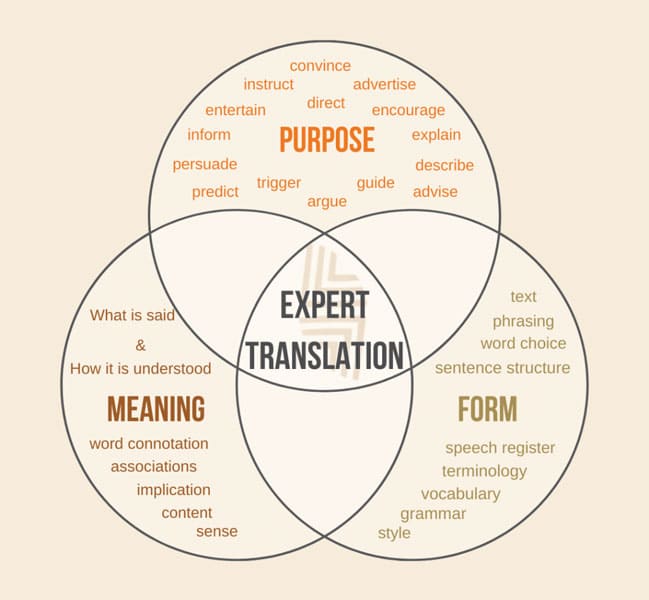
Only when all three elements work together and cohesively can you expect the best result from your multicultural marketing campaign.
When you translate your materials into another language, you naturally want to achieve the same effect on the new audience. You will not accomplish this through formal equivalence of language alone. Focus needs to be placed on the meaning and the purpose.
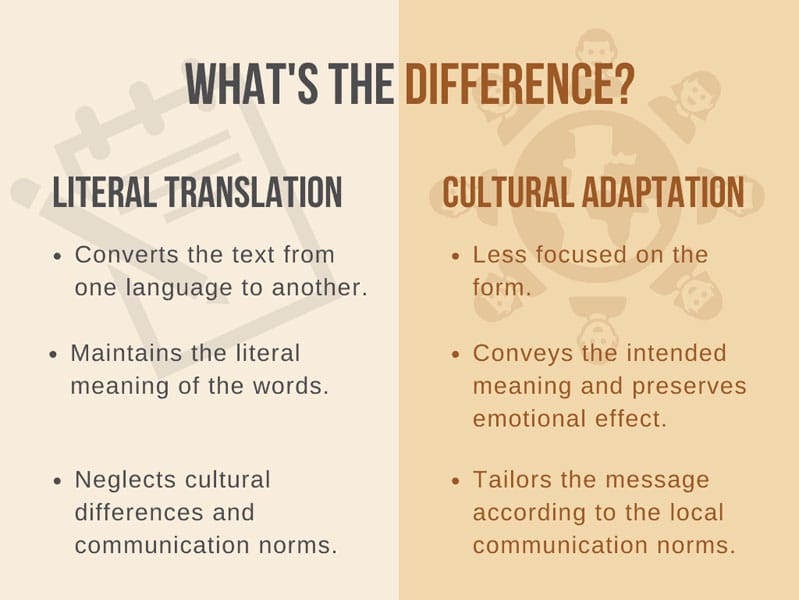
Word-for-word translation achieves formal equivalence but fails to fulfil its primary task -- to convey the original message to the speakers of another language. You must avoid literal translation and choose a comprehensive cultural adaptation to achieve the best result.
#
Cultural adaptation
The main character of your translation story is not the text but the person who will read it. Cultural adaptation entails a set of changes throughout the translation process. It makes the text not only linguistically correct but, most importantly, appropriate, familiar and relevant for the readers.
It is a shift in the cultural environment of your materials, which is inevitable when a certain element of the source text doesn't exist, can't be translated, or will have a different effect on the target language culture.
What undergoes cultural adaptation?
- Idioms or figures of speech that aren't universally understood
- Jargon, colloquialisms and slang
- Humour
- Socially sensitive and taboo topics (e.g. politics, sexuality, religion and sacred objects)
- References to concepts and realities that are familiar only to the speakers of the source language
- Content that can be considered offensive in the target culture
- Text layout
Summing up
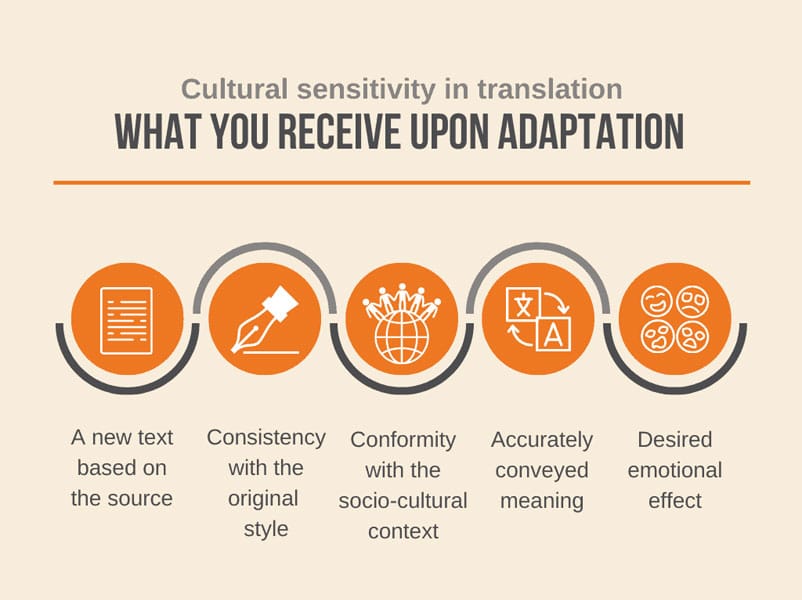
A culturally adapted content ticks all these boxes:
- It conveys the intended message
- It is consistent with the original style of the source text and the
author's voice
- It is a new text based on the source and not a word-for-word
translation
- It has the same emotional effect on the target audience as the
source text
- It is appropriate within the local socio-cultural context
- It resonates with the worldviews and communication norms of the
target audience
Conclusion
Translation is equally a linguistic and a socio-cultural process. To have the desired effect on the readers, the text should resonate with their historical, social and cultural sensitivity to reality. The ability to translate beyond words and speak to the unique ethnic characteristics of the target audience is what distinguishes a high quality translation. t's crucial to understand that non-cultural sensitivity and negligence to seemingly small details can significantly impact your multilingual communication campaign. Using inappropriate concepts and expressions or awkward and unnatural wording will lead to significant miscommunication, and confusion and will put off the reader. When developing a multilingual campaign, one should always bear in mind that distortion of the meaning and miscommunication can mean far greater costs to the business than investment in expert translators.